

Introduction
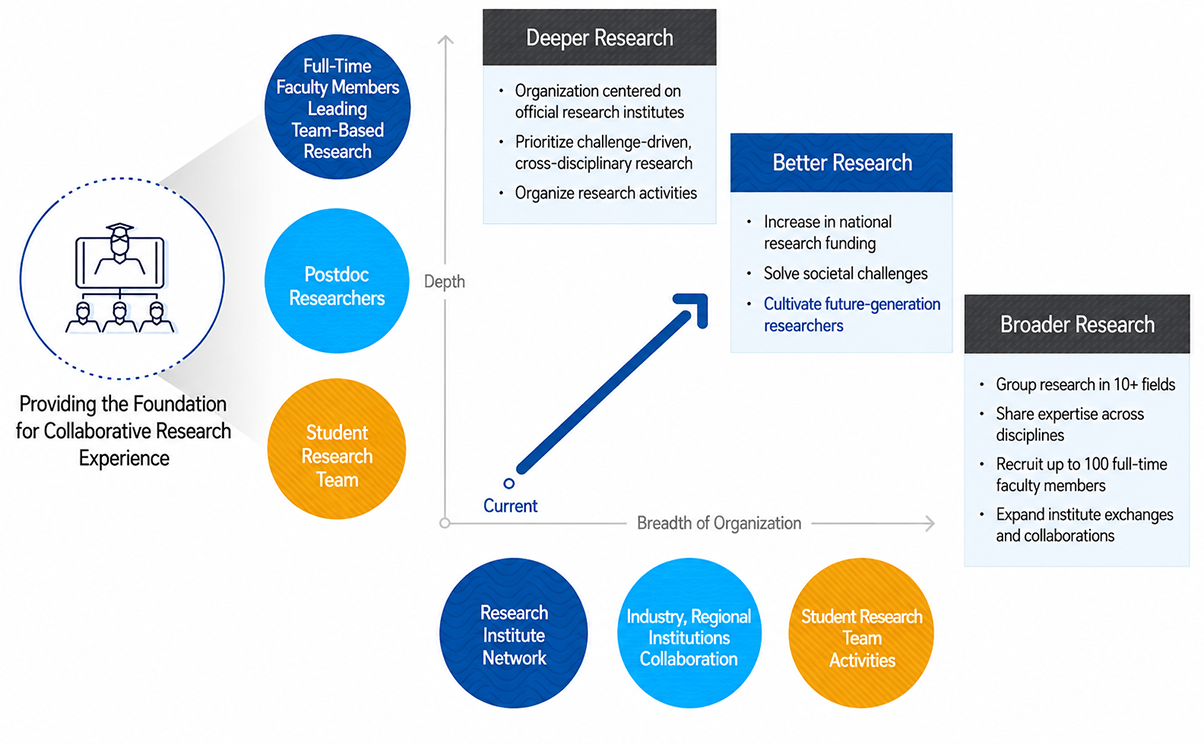
The Incheon National University Research Institute Student Research Group Support Program enhances the field orientation of university education and research through the execution of research projects by student-centered teams, and fosters the next generation of scholars with outstanding convergence capabilities by providing students with experience in conducting group research. By promoting research institute-based group research projects, it organizes research activities and fosters research convergence through the activation of research institute networks and the dissemination of research outcomes.
A group research-friendly student research group that understands group research well and practices inter-group collaboration effectively
Creating better research outcomes by supporting vertical and horizontal organization
Differences from general lab support
![2024 University Innovation Support Project Performance Sharing Forum, [University Innovation] Research Institute Student Research Group Excellence Award Ceremony and Performance Presentation, Date/Location: Feb. 06, 2025 (Thu) 13:30, Incheon National University Faculty Hall 3rd Floor Conference Room, Group Photo](/sites/inu/images/sub/img-diff.png)
Professors
University Research Institutes, Consortiums
(Selected through Institute Evaluation)
Understanding Research Institute Development Plans
Research Tailored to Local Community Needs
Passive
Role as a Lubricant Between Groups
Active Participation Subject
in Group Research
Driving Convergence Research
Deriving Network Application Points
2025 Research Institute Student Research Group Operation Status and Research Topics
| No. | Affiliation Institute | Student Research Group Name | Research Topic |
|---|---|---|---|
| 1 | Chemical Engineering Innovation Research Institute | EEDT | Development of fuel cell catalysts using laser treatment |
| 2 | EPAD | Performing first-principles modeling of SOFC+SOEC and applying it to Python-based process flow diagrams | |
| 3 | Chochelin | Acidity control of bifunctional catalysts via inter-zeolite structural transformation and its application to glucose conversion reactions | |
| 4 | DuoTFT | A study on improving the stability and gas sensing performance of organic transistors with antioxidant additives | |
| 5 | CSI | Formation of a stable solid electrolyte interphase via NCM coating | |
| 6 | Ligand | Enhancement of biocompatibility and sonodynamic therapeutic performance of PCN-222 via fullerene derivative and PEG conjugation | |
| 7 | Engineering Technology Research Institute | Intelligent Control System Research Group | Study on intelligent control algorithms to ensure operational safety of unmanned aerial vehicles (UAVs) |
| 8 | Datafluencers | Risk factor analysis and diffusion path exploration of artificial intelligence (AI) services based on text mining | |
| 9 | S2H Research Group | Development of photoelectrode materials for green hydrogen production using solar energy: Development of nanostructure-based photoelectrode materials for solar water splitting and evaluation of photoelectrochemical properties | |
| 10 | Materials and Device Theory Student Research Group B | This student research group conducts topological material device research based on understanding and interest in topological physics and knowledge of semiconductor engineering, aiming to propose topological material-based interconnect technology replacing Cu at linewidths under 10nm. | |
| 11 | Administrative Support Group | Engineering Technology Research Institute budget management, execution processing, and report support | |
| 12 | Incheon Disaster Prevention Research Center | CFEL | Process risk assessment of ammonia-hydrogen mixed fuel based on CA/PHAST and development of accident prediction models using machine learning: This study reflects physical/chemical characteristics and actual process scenarios of decarbonized fuels to analyze risk factors and link them to machine learning-based analysis to evaluate accident impact. |
| 13 | Nuclear Safety Research Institute | Nuclear Thermal-Hydraulics Computational Visualization Research Group | Performance improvement of passive cooling systems in nuclear power plants using phase change materials |
| 14 | SMR-Linked Energy Utilization Research Team | Development of high-performance and high-durability water electrolysis systems utilizing nuclear power generation | |
| 15 | i-SMR Safety Research Group | Derivation of core thermal-hydraulic models of MARS-KS (a regulatory verification code for light-water SMR accident analysis), feasibility evaluation for i-SMR safety analysis application, and derivation of improvement plans | |
| 16 | Innovative SMR Fully Passive Cooling Development Research Group | * Literature survey for fully passive cooling of innovative SMR * Design and development of preliminary models for passive residual heat removal verification * Review of key design parameters through reactor accident scenarios * Proposal of basic design for passive residual heat removal system |
|
| 17 | BMI Research Institute | Biofabrication | 1. Analysis of hydrogel nanofiber behavior injected into the brain 2. Development of methods for brain vascularization using scaffolds 3. Acquisition of cell image analysis techniques |
| 18 | IACELL Research Group | Improvement of cell image analysis by applying computer vision image analysis techniques and modifying existing cell image analysis software | |
| 19 | Drug Discovery and Development Research Institute | Immunomedical Nanotechnology Research Group | The research field of this Medical Nanoparticle Research Group is a convergence field encompassing bioscience/engineering knowledge, covering topics such as: - Development of improved artificial antibodies using antibody engineering - Development of cancer therapeutic nanoparticles combining advanced nanotechnology, artificial antibodies, and E. coli outer membrane vesicle technology |
| 20 | BactiBridge | Study on the activation mechanism of dormant bacteria | |
| 21 | Vector-Borne Infectious Diseases Convergence Research Center Consortium | Infectious Disease Vector Student Research Group | Research on data-driven quarantine systems through ecology and pathogen surveillance of livestock disease vector insects according to climate change |
| 22 | Infectious Disease Immunotherapy Research Group | Aiming to provide grounds for developing vaccines and therapeutics for vector-borne infectious diseases by identifying disease types, incidence status, and vaccine/drug development status, alongside studying T-cell immune response regulation mechanisms against infectious diseases. | |
| 23 | MiEMI | Research on beam-steering antenna and IT-based technologies for detecting beeswax accumulation on queen excluders inside bee colonies for smart beekeeping monitoring | |
| 24 | Bio-Material and Process Development Research Institute | Biomodeling Research Group | Development of therapeutics for type 1 diabetes using immunosuppressive cell-derived extracellular vesicles |
| 25 | Nanocarrier Research Group | Development of therapeutics for type 1 diabetes using immunosuppressive cell-derived extracellular vesicles | |
| 26 | Vesicle Wizards III | Research and literature review on the development of materials for biopharmaceuticals, cosmetics, food, and medical devices based on extracellular vesicles, which are small nanoparticles derived from cells or plants | |
| 27 | Biosystem Designers | Development of gene editing/gene expression regulation tools for non-model microorganism engineering and development of microbial systems for disease treatment/environmental remediation utilizing them | |
| 28 | Incheon Disaster Prevention Research Center | Structural Dynamics Laboratory | Development of phase-change energy storage aggregates using high-functionality CNT/polymer composite coating layers |
| 29 | Smart Structures and Materials Laboratory | Development of embedded energy harvesting and disaster prevention monitoring systems for structures using multifunctional conductive cement composites | |
| 30 | Asia Environment & Energy Research Institute | Radical | Removal of pollutants using peroxides and solid catalysts |
| 31 | BioScope | This student research group focuses on the quantitative analysis of antibiotic resistance genes (ARGs) in aquatic systems and evaluation of environmental influence factors, aiming to elucidate ARG dissemination causes through digital PCR-based ARG quantification and correlation assessments with environmental variables and indicator microorganisms across diverse water samples. | |
| 32 | AWT | Heavy metal adsorption through starfish-derived activated carbon | |
| 33 | ClimateCrew | Testing and performance verification of ECOPS, an eco-friendly air purification system for public facilities | |
| 34 | Next-Generation Energy Convergence Research Institute | Energy Device Team | Development of high-efficiency transparent Pyroelectric-Photovoltaic (TPV) devices using ZnO/NiO-based photothermal composite structures |
| 35 | High-Power Device Team | As the use of high-power semiconductor devices increases, the need for Large Band Gap Materials is growing. This study utilizes Plasma-Enhanced Atomic Layer Deposition (PEALD) equipment to grow GaO semiconductors and expand research into device applications. | |
| 36 | Thin Film Device Team | Fabrication of high-performance transparent heaters using AZO/AgNW-based composite electrodes and securing thermal reliability | |
| 37 | Eco-Friendly Electrical Energy Conversion Tech Development Team | Conducting research to effectively reduce current restoration errors in single current sensor methods used in fan, pump, and blower systems without motor parameters and additional hardware configurations. This is particularly effective for low-cost, small-scale applications. | |
| 38 | Basic Science Research Institute Consortium | OMSL-CO2 | Development of carbon dioxide separation membranes to reduce atmospheric greenhouse gases |
| 39 | THiN | 1. Systematically control various synthesis conditions (temperature, time, precursor concentration, etc.) to establish an experimental protocol capable of precisely controlling tellurium film thickness. 2. Quantitatively analyze the structure and thickness of deposited films using SEM, AFM, Raman spectroscopy, etc., and elucidate the correlation between thickness and physical properties. 3. Derive the optimal thickness range for nanoelectronic and optical device applications through thickness control, securing technologies to enhance film uniformity and reproducibility. |
|
| 40 | Algebraic Combinatorics Research Group | Combinatorial structures of crystal bases and q-characters of finite-dimensional representations of (quantum) loop algebras | |
| 41 | Nano Ultrafast Phenomenon Research Group | Particle size estimation using diffuse laser scattering according to angle of incidence changes in the Mie regime | |
| 42 | NABAHWA (나바화) | Development of biodegradable plastic degradation processes and discovery of degrading microorganisms | |
| 43 | MEGA Lab | Evaluation of the scalability of seaweed and halophyte cultivation technology through the application of microbubble technology | |
| 44 | INCAT | Development of electrochemical catalysts for water electrolysis cathodes targeting green hydrogen production and water treatment | |
| 45 | MOMEMT | A study on confirming the hybridization potential between introduced *Mercenaria mercenaria* and native species in Korea |
| No. | Affiliation Institute | Student Research Group Name | Research Topic |
|---|---|---|---|
| 1 | Humanities Research Institute | Korean Literature/Culture Translation Field | The practice and field of Korean literature and culture translation |
| 2 | Überstudentin | In-depth reading of 『Affect Theory』 | |
| 3 | LANGLANG | 1) Analysis of domestic French linguistics research trends over the past 10 years: Investigation and analysis of keywords/subfields in French linguistics across major accredited domestic journals 2) Investigation of recent topics in major French academic journals such as *Langue française* and *Langages*, focusing on core concepts via close reading of original papers in semantics |
|
| 4 | Japanese Art Magazine Research Group | This student research group explores media related to contemporary Japanese art. Specifically, it analyzes Japanese contemporary art magazines to discuss the present significance of art. Given Japan's well-developed magazine culture, art magazines play a vital role as media bridging academic research and the public. We aim to examine the relationship between contemporary art and media by analyzing influential publications with long histories, such as *Bijutsu Techo (美術手帖)*, *Geijutsu Shincho (芸術新潮)*, and *Eureka (ユリイカ)*. | |
| 5 | Incheon Academy | Urban Large-Scale Social Disaster Research Group | Research on large-scale urban social disasters |
| 6 | Science Gifted Education Research Institute | Future Creative Science Research Group | Analysis of scientific culture demands and participation effectiveness among Incheon citizens / Derivation of improvement plans for citizen-centric science culture programs |
| 7 | Institute of Social Sciences | Career Environment Research Group | Understanding future career environment changes and trends in searching for meaning at work |
| 8 | EduTechnopia | Exploration of instructional strategy cases utilizing generative AI across university academic fields | |
| 9 | MediaComm | Study on the positive effects of social media and YouTube media | |
| 10 | Social Welfare Team | Exploring social measures to address youth mental health issues | |
| 11 | LIS Student Research Group | Development directions for libraries as complex cultural spaces | |
| 12 | Sports Science Research Institute Consortium | nRRL | Effects of transcutaneous vagus nerve stimulation on various sleep parameters |
| 13 | ABL | Analysis of the impact of Center of Pressure (CoP) control on lower limb biomechanics during squat execution | |
| 14 | SMER | Measuring VO2max in swimmers with developmental disabilities: Comparative analysis of aquatic VO2max and treadmill VO2max | |
| 15 | STEPSTEP | Conducting a survey targeting elite student-athletes at Incheon National University to determine athletic stress and helplessness during matches and training. Based on this, a support program utilizing psychological measurements will be established to understand stress levels and promote mental health among INU athletes. | |
| 16 | Sports Aging Laboratory | Effects of combined voluntary wheel running and acetate ingestion on gut microbiota in menopausal model mice | |
| 17 | EBS | Impact of cognitive load on gait in Parkinson's disease patients and potential solutions | |
| 18 | Student Growth Support Group | Development and evaluation of programs to foster physical education career path setting competencies in high school students | |
| 19 | EPBL | Collecting baseline data through correlation analysis and blood glucose variability in metabolic syndrome patients | |
| 20 | Sports Social Phenomena Analysis Research Group | Policy development for cultivating community-based sports culture talent | |
| 21 | FRBL | Functional biomechanical characterization of direction-change movements in women with Patellofemoral Pain Syndrome (PFPS) | |
| 22 | ECPL | Effects of a 16-week elastic band resistance exercise program on arterial stiffness in older adults | |
| 23 | Chinese & Overseas Chinese Culture Research Institute Consortium | Sinophone Studies Administrative Support Group | Administrative support for various research projects, events, and academic activities related to Chinese studies |
| 24 | Overseas Chinese Studies Administrative Support Group | Administrative support required for research, education, and industry-academia collaboration activities related to China |