

INU Professor Cho Jung-wan Publishes First-Author Research Paper in the Prestigious Journal Nature Electronics
- NO
- 432875
- Date
- 2026-11-09
- modification day
- 2026-11-09
- Writer
- 홍보과 (032-835-9490)
- Count
- 1205
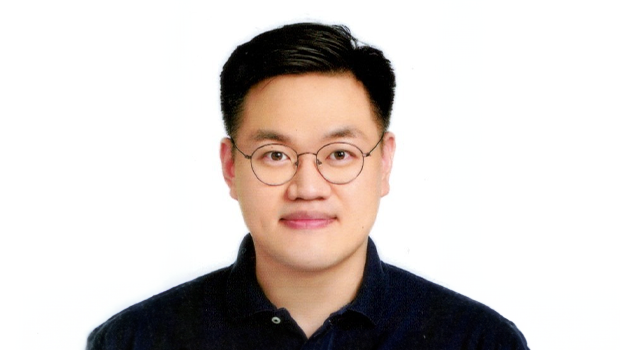

▲ Photo: Professor Cho Jung-wan of the Division of Electronics Engineering at Incheon National University (left) and the research paper published in Nature Electronics (right)
※ Paper source: Jo et al., Nature Electronics (2026), DOI: 10.1038/s41928-026-01670-9 (CC BY 4.0)
- Innovation in Next-Generation AR and VR Displays: Development of Crack-Assisted Transfer Printing (CATP) Technology
- Ultra-High-Resolution QD Pixel Patterning at 600 × 900 nm (16,933 ppi) and Demonstration of a Large-Area, Cadmium-Free (Cd-Free), Full-Color Active-Matrix QD Display
Incheon National University (INU), led by President Injae Lee, announced that a research paper authored by Professor Cho Jung-wan of the Division of Electronics Engineering as the first author has been published in Nature Electronics, one of the world's leading academic journals in electrical and electronic engineering.
Inorganic colloidal quantum dot light-emitting diodes (QD-LEDs) are considered a key technology for augmented reality (AR), virtual reality (VR), and next-generation large-area displays due to their excellent color purity, high optical efficiency, and electrical stability.
However, realizing practical, high-resolution, full-color QD displays requires a fabrication process capable of precisely forming ultrafine QD pixels without cross-contamination between red, green, and blue (RGB) pixels. The process must also enable uniform integration over large areas, including actual display substrates with surface height variations. Conventional QD patterning technologies have faced limitations in simultaneously achieving ultra-high resolution, large-area process compatibility, and applicability to practical display substrates.
In this study, Professor Cho Jung-wan and his fellow researchers developed a novel technique called Crack-Assisted Transfer Printing (CATP), which precisely controls the bonding forces between quantum dot (QD) particles at the nanoscale.
-
Ultra-High-Resolution Patterning: Using CATP, the researchers arranged QD pixels measuring 600 × 900 nm at a pixel density of 16,933 pixels per inch (ppi) and demonstrated electroluminescence, confirming the feasibility of fabricating ultrafine light-emitting pixels for ultra-high-resolution displays.
-
Large-Area Substrate Compatibility and Successful Patterning on Uneven Surfaces: By introducing a micro-bump stamp equipped with air-release channels, the researchers resolved the air-bubble entrapment issues that can occur in conventional transfer processes. They achieved a transfer yield approaching 100%, even on actual display substrates featuring pixel-defining banks with a depth of 1.5 μm.
-
Environmentally Friendly Cadmium-Free (Cd-Free) Displays: Using cadmium-free QDs based on indium phosphide (InP) and zinc telluride selenide (ZnTeSe), the team successfully demonstrated a 1.41-inch, full-color, active-matrix QD display with a resolution of 341 ppi and a color gamut equivalent to 124% of sRGB.
-
Improved Device Performance and Operational Lifetime: Red QD-LEDs fabricated using CATP achieved a maximum luminance of 40,150 cd/m² and a maximum external quantum efficiency (EQE) of 4.54%. The high packing density of QDs also reduced leakage current and significantly improved device operational lifetime.
Professor Cho Jung-wan stated, “CATP technology represents a new approach that overcomes the limitations of conventional patterning techniques by introducing nanomechanical crack control into the display transfer process.”
He added, “We expect this technology to evolve into a next-generation manufacturing platform applicable not only to environmentally friendly, cadmium-free QD displays but also to ultra-high-resolution microdisplays for AR and VR, as well as flexible and wearable displays.”
The research findings were published in the September 2026 issue of Nature Electronics, a globally renowned academic journal. The journal's 2025 impact factor was 42.3, ranking first in the Engineering, Electrical & Electronic category.
INU's Office of Research Affairs operates various internal research support programs, including INU SURE LAB (SUstainable Human REsource Management Program for Research LAB), university-funded research grants, and faculty academic activity funding.
Through these initiatives, the University supports its advancement as a research-focused institution and promotes world-class research achievements, such as Professor Cho Jung-wan's work, under its vision of becoming a “Research Innovation Platform Connecting the Region to the World.”

▲ Research Image: Process principles of Crack-Assisted Transfer Printing (CATP) technology and results of ultra-high-resolution QD pixel fabrication
※ Source: Jo et al., Nature Electronics (2026), DOI: 10.1038/s41928-026-01670-9 (CC BY 4.0, partially adapted)
- Attachment
- There are no attachments.