INU Research Team Designs Ultra-Low-Power Topological Transistor for Quantum Computing Implementation
- 글번호
- 421560
- 작성일
- 2026-03-23
- 수정일
- 2026-03-23
- 작성자
- 홍보과 (032-835-9490)
- 조회수
- 43

From left: Yosep Park (master’s student, first author), Yun-kyung Park (master’s student, co-author), Hyun-seok Choi (master’s student, co-author), Su-bin Lim (master’s student, co-author), and Young-hoon Lee (Professor, corresponding author)
A research team led by Professor Young-hoon Lee from the School of Electrical Engineering and the Department of Intelligent Semiconductor Engineering at Incheon National University has successfully theoretically designed an ultra-low-power topological transistor that can be utilized in cryogenic electronic interfaces for large-scale quantum computing systems.
To realize large-scale quantum computing systems, cryogenic (below 4K) electronic control and readout circuits connected to quantum processors are essential. However, conventional III–V high electron mobility transistors (HEMTs) suffer from excessive power consumption that exceeds the cooling capacity of cryogenic systems, limiting large-scale qubit integration.
To address this issue, the INU research team proposed and analyzed a novel device structure called NC-TIFET (Negative-Capacitance Topological Insulator Field-Effect Transistor). This device combines the intrinsic topological properties of the two-dimensional topological insulator 1T′-MoS₂ with the negative capacitance effect of a ferroelectric gate insulator, HZO (hafnium–zirconium oxide).
According to the team’s theoretical analysis, the NC-TIFET achieved a switching voltage below 20 mV at a drain voltage of 0.05 V under cryogenic conditions (4K), and demonstrated an exceptionally high transconductance (gm) of 26 S/mm at 0.1 V. This performance is more than 30 times higher than the best reported experimental values of cryogenic HEMTs (0.8 S/mm), indicating a significant potential to drastically reduce power consumption in cryogenic electronic interfaces for large-scale quantum computing.
Professor Young-hoon Lee stated, “This study presents a new transistor concept that surpasses the power consumption limitations of conventional HEMTs by combining the unique physical properties of topological insulators with the negative capacitance effect of ferroelectrics.” He added, “If future research successfully stabilizes the metastable phase of 1T′-MoS₂ and achieves experimental implementation, it could make a substantial contribution to the practical realization of large-scale quantum computing systems.”
The research findings were published in February in the internationally renowned nanotechnology journal Nano Letters, and were also selected as a Supplementary Cover article. The paper is titled:
“Designing Extremely Low-Power Topological Transistors with 1T′-MoS₂ and HZO for Cryogenic Applications.”
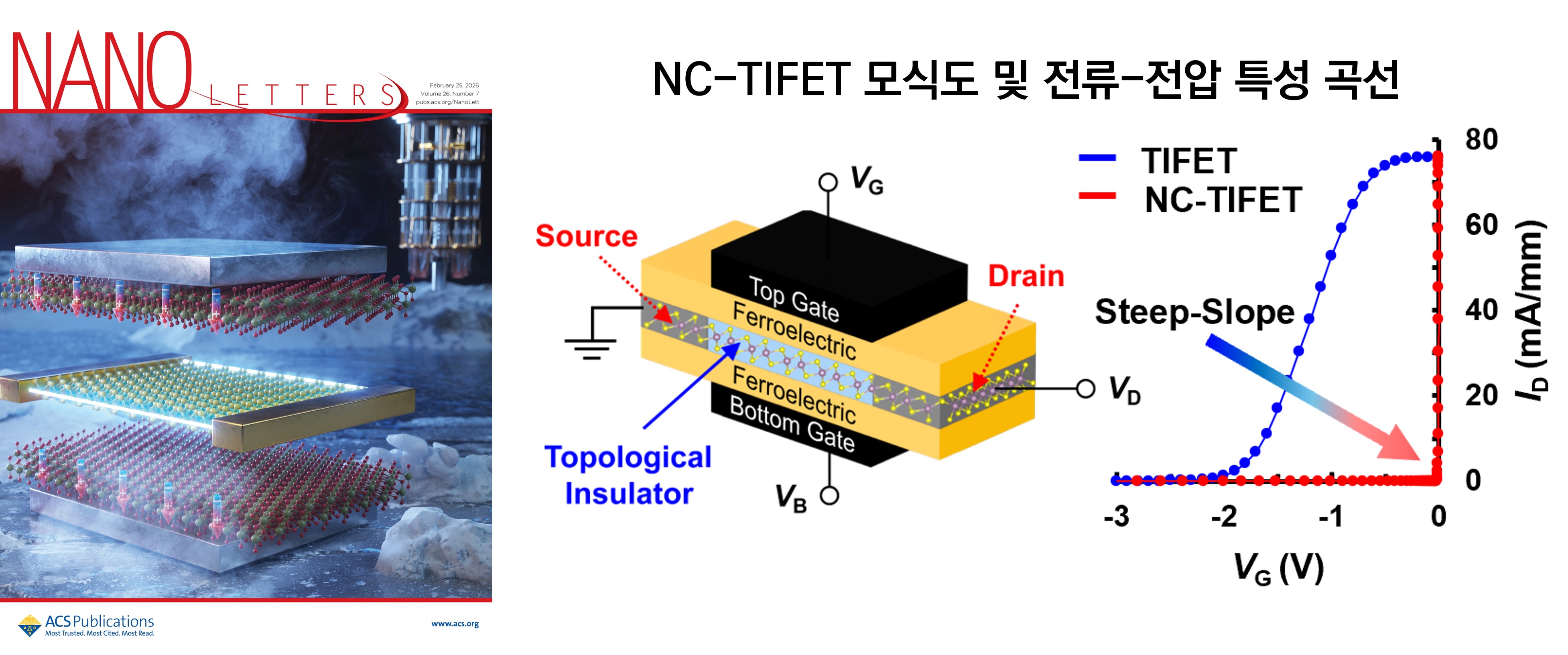
The Nano Letters cover (left) features a conceptual illustration of a ferroelectric-based topological insulator transistor (NC-TIFET) applicable to cryogenic electronic interfaces for quantum computing. The schematic (right) shows the NC-TIFET structure and the sharp switching characteristics enabled by the introduction of ferroelectric materials.